Echoregions Regions2D Plotting and Masking Demonstration#
Prior to running this notebook and all other notebooks, make sure you have installed the packages found in requirements.txt.
This notebook demonstrates some of the functionalities of echoregions to read Echoview region .evr files and visualize regions.
import matplotlib.pyplot as plt
import xarray as xr
import numpy as np
import echoregions as er
import warnings
import urllib.request
import gdown
warnings.filterwarnings("ignore", category=DeprecationWarning)
# download an example file
urllib.request.urlretrieve("https://raw.githubusercontent.com/OSOceanAcoustics/echoregions/main/echoregions/test_data/x1.evr","x1.evr")
EVR_FILE = 'x1.evr'
Get a Regions2D object with read_evr#
r2d = er.read_evr(EVR_FILE)
Plotting#
# Display availible regions
r2d.data.region_id.values
<IntegerArray>
[ 1,  2,  3,  4,  5,  6,  7,  8,  9, 10, 11, 12, 13, 14, 15, 16, 17, 18, 19,
 20, 22, 23, 24, 25, 26, 27, 28, 29, 30, 32, 33, 34, 35]
Length: 33, dtype: Int64
# let's select one id
region_ids = [11]
# Plot a region with a specific id with the `plot` function
r2d.plot(region_ids[0])

# Plot a closed region by using close_region=True.
# Optionally provide matplotlib kwargs for more customization.
r2d.plot(region_ids[0], close_region=True, color='k', alpha=.5, marker='x', markeredgecolor='red', markersize=12)

r2d.select_region(region_ids)
| file_name | file_type | evr_file_format_number | echoview_version | region_id | region_structure_version | region_point_count | region_selected | region_creation_type | dummy | ... | region_bbox_right | region_bbox_top | region_bbox_bottom | region_class | region_type | region_name | time | depth | region_notes | region_detection_settings | |
|---|---|---|---|---|---|---|---|---|---|---|---|---|---|---|---|---|---|---|---|---|---|
| 10 | x1 | EVRG | 7 | 12.0.341.42620 | 11 | 13 | 10 | 0 | 2 | -1 | ... | 2017-06-25 20:02:08.535700 | 102.255201 | 127.947603 | Unknown | 1 | Chicken nugget | [2017-06-25T20:01:47.093000000, 2017-06-25T20:... | [102.2552007996, 103.7403107496, 109.532239554... | [] | [] |
1 rows × 22 columns
Plotting regions on an echogram#
Reading Preprocessed Sonar Files#
We have converted and calibrated the echosounder files corresponding to one transect and stored them in .zarr. We can directly read them with the xarray library.
# mounting the google drive (uncomment if you have permission to read directly from Google Drive)
# from google.colab import drive
# drive.mount('/content/drive/')
# Paths for Google Drive read  (uncomment if you have permission to read directly from Google Drive)
# ZARR_PATH = '/content/drive/Shareddrives/uw-echospace/shared_data/SH1707/x1.zarr'
# download a zipped sample folder from publicly available Google Drive
url = 'https://drive.google.com/uc?id=1OhYVcakCEgXEKA4R9za4jvBWQUFIOnE5'
output = 'x1.tar.gz'
gdown.download(url, output, quiet=False)
# Unzip into a sample folder
!tar -xvzf  x1.tar.gz
tar: Error opening archive: Failed to open 'x1.tar.gz'
ds = xr.open_dataset("x1.zarr")
c:\Users\cmtug\OneDrive\Documents\GitHub\echoregions\.conda\lib\site-packages\xarray\backends\plugins.py:139: RuntimeWarning: 'netcdf4' fails while guessing
  warnings.warn(f"{engine!r} fails while guessing", RuntimeWarning)
c:\Users\cmtug\OneDrive\Documents\GitHub\echoregions\.conda\lib\site-packages\xarray\backends\plugins.py:139: RuntimeWarning: 'h5netcdf' fails while guessing
  warnings.warn(f"{engine!r} fails while guessing", RuntimeWarning)
c:\Users\cmtug\OneDrive\Documents\GitHub\echoregions\.conda\lib\site-packages\xarray\backends\plugins.py:139: RuntimeWarning: 'scipy' fails while guessing
  warnings.warn(f"{engine!r} fails while guessing", RuntimeWarning)
ds
<xarray.Dataset>
Dimensions:                (channel: 3, ping_time: 13192, range_sample: 3957)
Coordinates:
  * channel                (channel) object 'GPT  18 kHz 009072058c8d 1-1 ES1...
  * ping_time              (ping_time) datetime64[ns] 2017-06-25T15:04:30.076...
  * range_sample           (range_sample) int64 0 1 2 3 ... 3953 3954 3955 3956
Data variables: (12/13)
    Sv                     (channel, ping_time, range_sample) float64 ...
    depth                  (channel, ping_time, range_sample) float64 ...
    echo_range             (channel, ping_time, range_sample) float64 ...
    equivalent_beam_angle  (channel) float64 ...
    frequency_nominal      (channel) float64 ...
    gain_correction        (channel) float64 ...
    ...                     ...
    sa_correction          (channel) float64 ...
    salinity               float64 ...
    sound_absorption       (channel, ping_time) float64 ...
    sound_speed            (channel, ping_time) float64 ...
    temperature            float64 ...
water_level (channel, ping_time) float64 ...The dataset has a range_sample dimension and instead we convert it to a depth dimension by adjusting the water level.
# create depth coordinate:
echo_range = ds.echo_range.isel(channel=0, ping_time=0)
# assuming water levels are same for different frequencies and location_time
depth = ds.water_level.isel(channel=0, ping_time=0) + echo_range
depth = depth.drop_vars('channel')
# creating a new depth dimension
ds['depth'] = depth
ds = ds.swap_dims({'range_sample': 'depth'})
ds
<xarray.Dataset>
Dimensions:                (channel: 3, ping_time: 13192, depth: 3957)
Coordinates:
  * channel                (channel) object 'GPT  18 kHz 009072058c8d 1-1 ES1...
  * depth                  (depth) float64 9.15 9.15 9.15 ... 758.1 758.3 758.5
  * ping_time              (ping_time) datetime64[ns] 2017-06-25T15:04:30.076...
    range_sample           (depth) int64 0 1 2 3 4 ... 3952 3953 3954 3955 3956
Data variables:
    Sv                     (channel, ping_time, depth) float64 ...
    echo_range             (channel, ping_time, depth) float64 ...
    equivalent_beam_angle  (channel) float64 ...
    frequency_nominal      (channel) float64 ...
    gain_correction        (channel) float64 ...
    pressure               float64 ...
    sa_correction          (channel) float64 ...
    salinity               float64 ...
    sound_absorption       (channel, ping_time) float64 ...
    sound_speed            (channel, ping_time) float64 ...
    temperature            float64 ...
water_level (channel, ping_time) float64 ...# set the min and max depth based on the sonar files
r2d.min_depth = ds.depth.min()
r2d.max_depth = ds.depth.max()
r2d.select_region(region_ids[0])
| file_name | file_type | evr_file_format_number | echoview_version | region_id | region_structure_version | region_point_count | region_selected | region_creation_type | dummy | ... | region_bbox_right | region_bbox_top | region_bbox_bottom | region_class | region_type | region_name | time | depth | region_notes | region_detection_settings | |
|---|---|---|---|---|---|---|---|---|---|---|---|---|---|---|---|---|---|---|---|---|---|
| 10 | x1 | EVRG | 7 | 12.0.341.42620 | 11 | 13 | 10 | 0 | 2 | -1 | ... | 2017-06-25 20:02:08.535700 | 102.255201 | 127.947603 | Unknown | 1 | Chicken nugget | [2017-06-25T20:01:47.093000000, 2017-06-25T20:... | [102.2552007996, 103.7403107496, 109.532239554... | [] | [] |
1 rows × 22 columns
region_df = r2d.select_region(region_ids)
region_df
| file_name | file_type | evr_file_format_number | echoview_version | region_id | region_structure_version | region_point_count | region_selected | region_creation_type | dummy | ... | region_bbox_right | region_bbox_top | region_bbox_bottom | region_class | region_type | region_name | time | depth | region_notes | region_detection_settings | |
|---|---|---|---|---|---|---|---|---|---|---|---|---|---|---|---|---|---|---|---|---|---|
| 10 | x1 | EVRG | 7 | 12.0.341.42620 | 11 | 13 | 10 | 0 | 2 | -1 | ... | 2017-06-25 20:02:08.535700 | 102.255201 | 127.947603 | Unknown | 1 | Chicken nugget | [2017-06-25T20:01:47.093000000, 2017-06-25T20:... | [102.2552007996, 103.7403107496, 109.532239554... | [] | [] |
1 rows × 22 columns
region_ids
[11]
M = r2d.mask(ds.Sv.isel(channel=0).drop('channel'), region_ids, mask_var="ROI")
# the mask has nan's where outside of the region
M.shape
(3957, 13192)
# the region is labeled by default with 0 (if there are more regions they will be labeled 1,2,3,...)
M.max()
<xarray.DataArray 'ROI' ()>
array(0.)
# M.plot(yincrease=False)
# r2d.plot(region_ids, close_region=True, color='r')
M.sel(ping_time=slice('2017-06-25T20:00:00', '2017-06-25T20:20:00')).plot(yincrease=False)
<matplotlib.collections.QuadMesh at 0x2af21c755a0>

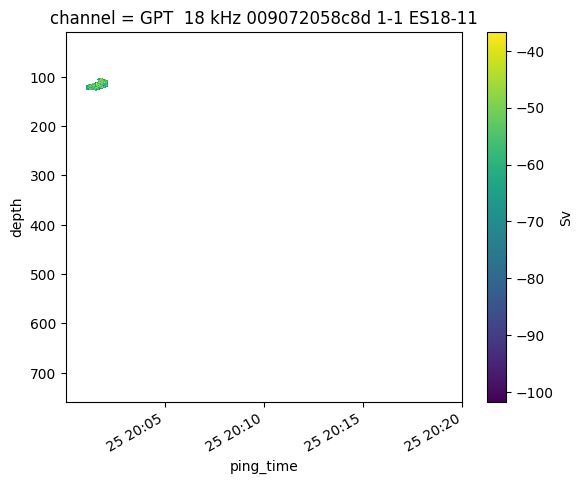
We can also create a masked sonar file:
Sv_masked = ds.Sv.where(~M.isnull())
# we limit the time range so that we see the small region
Sv_masked.sel(ping_time=slice('2017-06-25T20:00:00', '2017-06-25T20:20:00')).isel(channel=0).T.plot(yincrease=False)
<matplotlib.collections.QuadMesh at 0x2af21f2d960>
Multiple Region Mask#
The mask function can make a mask for several regions simultaneously:
region_ids = [10, 11]
r2d.select_region(region_ids)
| file_name | file_type | evr_file_format_number | echoview_version | region_id | region_structure_version | region_point_count | region_selected | region_creation_type | dummy | ... | region_bbox_right | region_bbox_top | region_bbox_bottom | region_class | region_type | region_name | time | depth | region_notes | region_detection_settings | |
|---|---|---|---|---|---|---|---|---|---|---|---|---|---|---|---|---|---|---|---|---|---|
| 9 | x1 | EVRG | 7 | 12.0.341.42620 | 10 | 13 | 4 | 0 | 4 | -1 | ... | 2017-06-25 19:13:12.607500 | 9.244758 | 758.973217 | Side station | 0 | Region10 | [2017-06-25T17:57:09.687500000, 2017-06-25T17:... | [9.2447583998, 758.9732173069, 758.9732173069,... | [] | [] |
| 10 | x1 | EVRG | 7 | 12.0.341.42620 | 11 | 13 | 10 | 0 | 2 | -1 | ... | 2017-06-25 20:02:08.535700 | 102.255201 | 127.947603 | Unknown | 1 | Chicken nugget | [2017-06-25T20:01:47.093000000, 2017-06-25T20:... | [102.2552007996, 103.7403107496, 109.532239554... | [] | [] |
2 rows × 22 columns
r2d.data['time'][10].min()
numpy.datetime64('2017-06-25T20:00:59.180700000')
r2d.data['time'][10].max()
numpy.datetime64('2017-06-25T20:02:08.535700000')
M = r2d.mask(ds.Sv.isel(channel=0).drop('channel'), region_ids, mask_var="ROI")
# select range so that we see the regions
M.sel(ping_time=slice('2017-06-25T17:00:00', '2017-06-25T20:20:00')).plot(yincrease=False)
<matplotlib.collections.QuadMesh at 0x2af2211bc40>
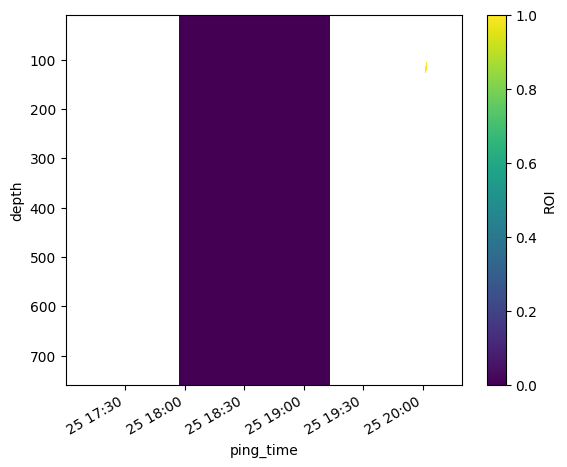
# now the mask has labeled the regions 0 and 1, and rest is nan
np.unique(M.data)
array([ 0., 1., nan])
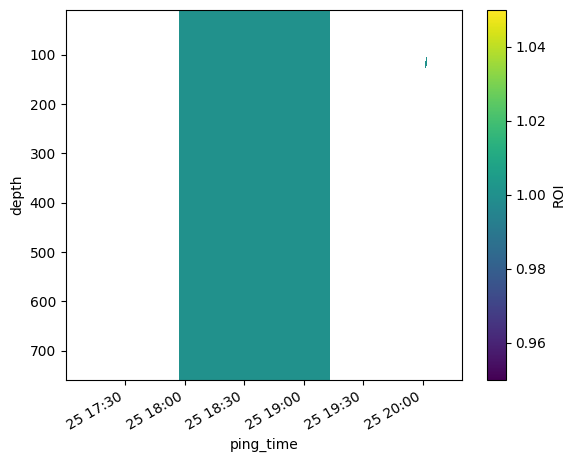
If one wants to label the regions with explicit values they can pass them through the mask_labels variable as a list of integers.
M = r2d.mask(ds.Sv.isel(channel=0).drop('channel'), region_ids, mask_var="ROI", mask_labels=[1, 1])
# select range so that we see the regions
M.sel(ping_time=slice('2017-06-25T17:00:00', '2017-06-25T20:20:00')).plot(yincrease=False)
<matplotlib.collections.QuadMesh at 0x2af21d39660>
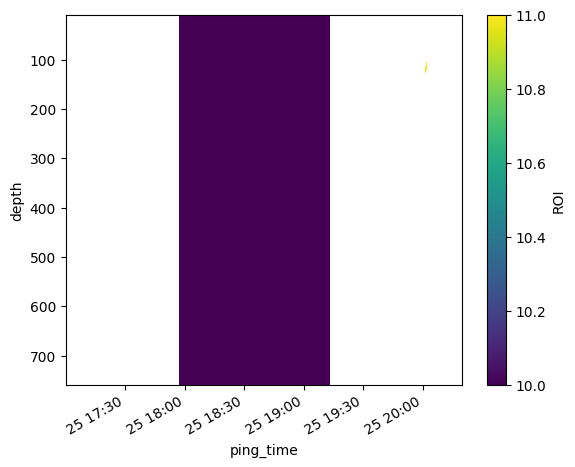
Alternatively, one could use the default ids from the .evr files.
M = r2d.mask(ds.Sv.isel(channel=0).drop('channel'), region_ids, mask_var="ROI", mask_labels="from_ids")
# select range so that we see the regions
M.sel(ping_time=slice('2017-06-25T17:00:00', '2017-06-25T20:20:00')).plot(yincrease=False)
<matplotlib.collections.QuadMesh at 0x2af22526fe0>